Plumbing companies operate in a fast-response, service-driven environment where missed calls, delayed dispatching, and disorganized scheduling directly impact revenue. Unlike project-based trades, plumbing businesses handle a continuous flow of service requests—ranging from urgent emergencies to routine maintenance—requiring real-time coordination between office staff, technicians, and customers.
A plumbing virtual assistant is a remote operations professional who supports the administrative, communication, and coordination tasks that keep service operations running efficiently. These assistants handle repeatable workflows so business owners, dispatchers, and technicians can focus on diagnosing issues, completing jobs, and serving customers on-site.
As plumbing companies grow, the volume of inbound calls, scheduling requests, and administrative work increases rapidly. Virtual assistants help manage this demand, ensuring that service requests are handled consistently and without delays.
Why Plumbing Companies Hire Virtual Assistants
Plumbing businesses operate under constant time pressure. Customers dealing with a leak, clog, or water heater failure expect an immediate response—and will move on to a competitor if they don't get one. At the same time, technicians need clear schedules, dispatchers need accurate information, and jobs must be logged and followed up without falling through the cracks.
Many companies look for a virtual assistant for plumbers because demand is unpredictable. Emergency calls, same-day service requests, and seasonal spikes—like frozen pipes in winter or sump pump failures in spring—can overwhelm in-house teams without warning. Missed calls or slow responses often result in lost jobs that cannot be recovered.
Virtual assistants provide operational reliability by handling high-frequency, time-sensitive tasks. This allows plumbing companies to:
- Capture more inbound service requests without hiring additional staff
- Maintain consistent communication with customers throughout the service cycle
- Reduce scheduling errors and dispatch confusion
- Extend availability beyond standard business hours
By offloading administrative execution, plumbing teams can focus on completing more jobs and improving service quality.
Cost of Hiring a Plumbing Virtual Assistant
Hiring local office staff for dispatching and administrative roles increases fixed overhead due to salaries, benefits, workspace, and equipment costs.
With access to global talent, the cost of a plumbing virtual assistant typically ranges between $3 to $7 per hour, depending on experience, skill level, and language capabilities.
This creates a more flexible cost model:
- No payroll taxes or employee-related expenses
- No office space or hardware requirements
- Pay only for actual hours worked
- Ability to scale support up or down as demand changes
For plumbing companies managing fluctuating call volumes, this approach maintains operational capacity without long-term financial commitments.
Operational ROI for Plumbing Companies
In plumbing, revenue is driven by speed of response and job volume. Service calls typically range from $150 for routine drain cleaning to $2,000 or more for emergency repairs and repipes. Capturing just a handful of additional jobs each month through faster response and better follow-up can quickly offset the cost of a virtual assistant.
Virtual assistants contribute directly to revenue by:
- Reducing missed calls and capturing more service requests
- Improving response times for inbound inquiries
- Keeping technician schedules optimized and fully booked
- Following up on estimates and incomplete jobs
- Supporting renewal of maintenance agreements and service contracts
The recurring revenue dimension is particularly relevant for plumbing companies that offer maintenance plans, water heater service agreements, or commercial building contracts. Virtual assistants help manage the scheduling and communication required to keep these accounts active and renewing—adding predictable revenue that compounds over time.
24/7 Call Handling and Service Requests
Plumbing is a service category where urgency is everything. Customers dealing with a burst pipe or sewage backup are not comparing prices—they are calling until someone picks up. The company that responds first typically gets the job.
Virtual assistants enable continuous availability by:
- Answering inbound calls and messages outside business hours
- Scheduling service appointments in real time
- Following up on missed calls and voicemail immediately
- Ensuring every inquiry is handled by a real person
This ensures that plumbing companies do not lose emergency opportunities due to unavailability—particularly overnight, on weekends, or during high-volume periods when in-house staff are overwhelmed.
Multilingual Customer Support
Plumbing companies in many markets serve a multilingual customer base. Communication breakdowns during scheduling or service calls—especially in urgent situations—can result in incorrect job details, no-shows, or customer dissatisfaction.
Virtual assistants with language capabilities help bridge this gap by:
- Handling service calls and inquiries in the customer's preferred language
- Ensuring job details, addresses, and service needs are captured accurately
- Reducing scheduling errors caused by miscommunication
- Building trust with customers who may otherwise struggle to communicate clearly
For plumbing businesses in diverse metro markets, multilingual support is a meaningful operational advantage.
What a Plumbing Virtual Assistant Can Handle
A plumbing virtual assistant can manage most administrative and coordination tasks that do not require physical presence.
Lead & Call Handling
- Answering inbound calls and responding to service inquiries
- Logging job requests into CRM or dispatch systems such as ServiceTitan, Housecall Pro, or Jobber
- Qualifying service needs before scheduling
- Following up on missed calls and voicemail inquiries
- Managing online bookings and web form submissions
This ensures that every potential job is captured and processed efficiently.
Dispatching & Scheduling
- Scheduling service calls and optimizing technician routes
- Assigning jobs based on availability, location, and skill set
- Updating customers on arrival times and delays
- Adjusting schedules in real time as priorities change
- Managing recurring maintenance and service agreement appointments
This improves technician utilization and reduces downtime between jobs.
Administrative Support
- Maintaining accurate customer and job records
- Updating CRM and service management platforms
- Processing invoices and basic billing tasks
- Organizing service history and job documentation
- Preparing internal reports for operations tracking
This keeps operations organized and data reliable across the business.
Estimates and Follow-Ups
- Sending estimates and service summaries to customers
- Following up on pending approvals
- Tracking unscheduled or postponed jobs
- Re-engaging past customers for additional services or plan renewals
This increases conversion rates and supports repeat business.
Customer Communication and Reviews
- Confirming appointments and sending reminders
- Providing updates on technician arrival and job status
- Handling post-service follow-ups
- Requesting customer reviews and feedback
This strengthens reputation and improves local visibility.
How Virtual Assistants Fit Into Plumbing Operations
Plumbing companies run on speed and information accuracy. When a dispatcher has the wrong address, a technician arrives unprepared, or a follow-up call never happens, jobs are delayed and customers are lost. Virtual assistants reduce these failure points by owning the communication and data layer between customers and field teams.
They integrate directly into the systems plumbing companies already use—whether that's ServiceTitan, Jobber, Housecall Pro, or a simpler CRM—and work within established workflows rather than adding new complexity.
For businesses managing high inbound call volume, structured support similar to a customer support virtual assistant provides the communication framework needed to handle service requests consistently and without dropped opportunities.
By handling execution tasks consistently, virtual assistants:
- Reduce internal workload on dispatchers and office staff
- Improve response times across all inbound channels
- Prevent scheduling gaps and missed service opportunities
- Maintain accurate operational data across systems
Who This Is For
This model works best for plumbing companies that:
- Receive consistent inbound service calls
- Manage multiple technicians or crews
- Offer or want to offer maintenance agreements and service contracts
- Experience scheduling or dispatch bottlenecks during peak periods
- Want to increase job volume without adding overhead
Who This Is Not For
This is typically not a fit for:
- Very early-stage plumbing businesses with low and irregular call volume
- Solo operators without defined scheduling or dispatch workflows
- Companies without basic systems for managing and tracking jobs
Virtual assistants are most effective when integrated into existing processes, not used as a replacement for them.
How Plumbing Companies Scale with Virtual Assistants
Growth in plumbing is often constrained not by demand, but by how many calls can be handled and how efficiently jobs are dispatched. As service volume increases, the coordination burden on in-house staff grows—and without support, quality and response times begin to slip.
Virtual assistants allow plumbing companies to scale by:
- Separating administrative execution from field operations
- Creating structured, repeatable dispatch and communication workflows
- Increasing job capacity without increasing fixed costs
- Supporting maintenance contract management as recurring revenue grows
- Maintaining consistent service quality as total volume expands
Over time, virtual assistants become embedded in daily operations—handling the tasks that keep the business running while owners and technicians focus on the work that drives revenue.
How to Hire a Plumbing Virtual Assistant
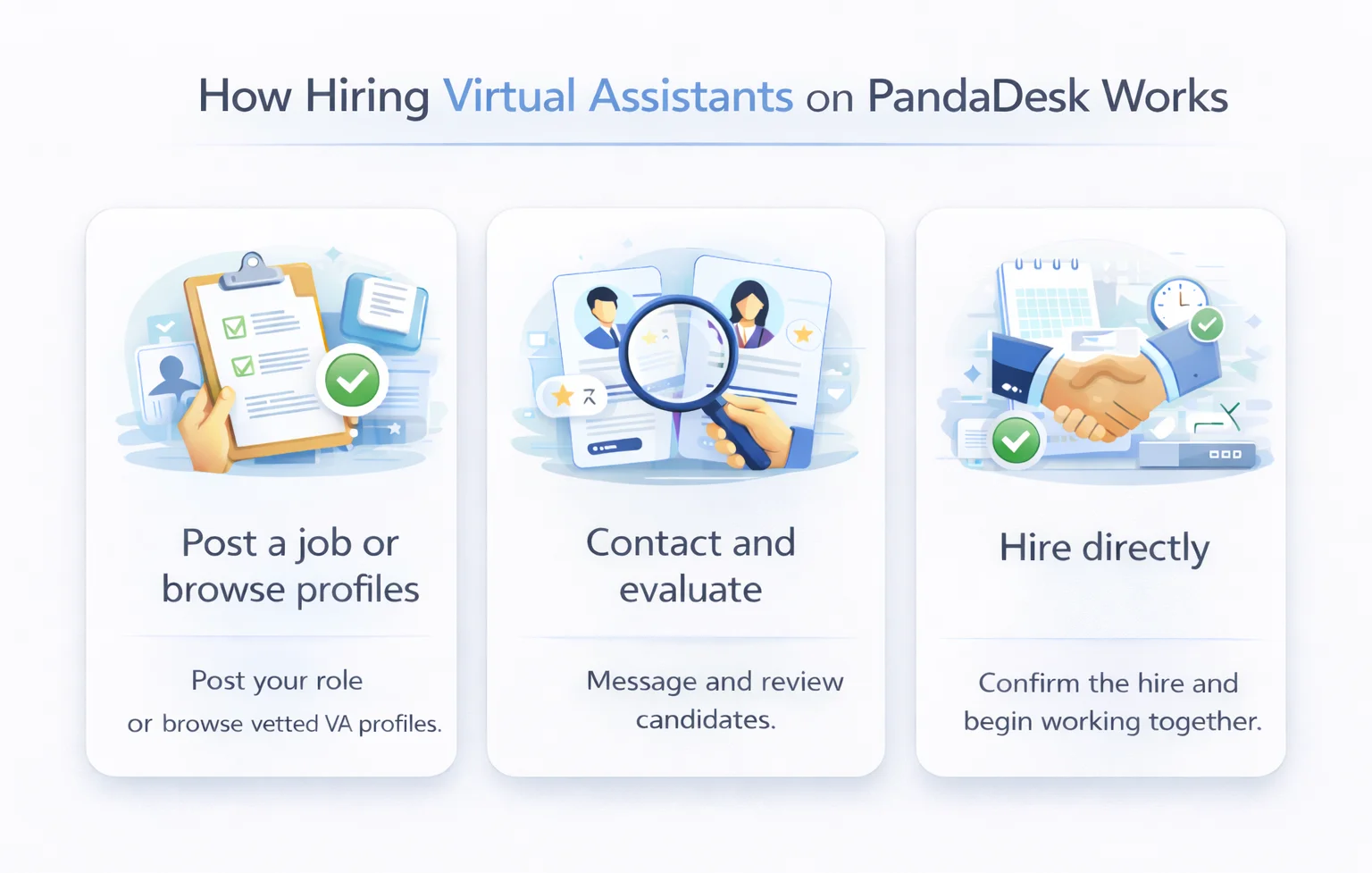
Hiring on PandaDesk is structured to match plumbing companies with virtual assistants who understand service-based workflows and real-time operational demands.
Explore Related Virtual Assistant Support
Learn how virtual assistants support high-volume inbound operations across service-based businesses.